
How to Calculate the True Profit Margin of Cosmetic Products Without Missing Hidden Costs
Read in English | Lire en Français | Leer en Español | Lesen auf Deutsch
For many beauty brands, increasing sales should naturally lead to higher profits. In reality, however, many founders experience the opposite: sales continue to grow, but cash flow remains tight, and annual financial reviews reveal profits far below expectations.
This isn't necessarily because products aren't selling—it’s often because the true profit margin has never been accurately calculated. Looking only at manufacturing cost versus selling price overlooks numerous hidden expenses that quietly erode profitability.
If you're a beauty brand founder or product manager, understanding your complete cost structure is essential for building a sustainable business.
What Is a True Profit Margin?
Many brands use a simple calculation when pricing a new product:
Selling Price – Manufacturing Cost = Profit
For example:
Manufacturing cost of a mascara: $3.00
Selling price: $10.00
At first glance, it appears the product generates a $7.00 profit, suggesting a healthy margin.
However, this figure only represents the gross margin—not the actual profit your business keeps.
A cosmetic product involves far more costs than manufacturing alone. Additional expenses often include:
Product formulation and R&D
Sample development
Packaging design
Packaging materials
Regulatory testing and compliance
Warehousing and logistics
Marketplace or distributor commissions
Marketing and advertising
Customer service
Product returns and refunds
Inventory carrying costs
Operational overhead
Only after accounting for these expenses can you determine the product's real profitability.
How to Calculate the True Profit Margin
A more accurate formula is:
True Profit Margin = (Sales Revenue – Total Costs) ÷ Sales Revenue × 100%
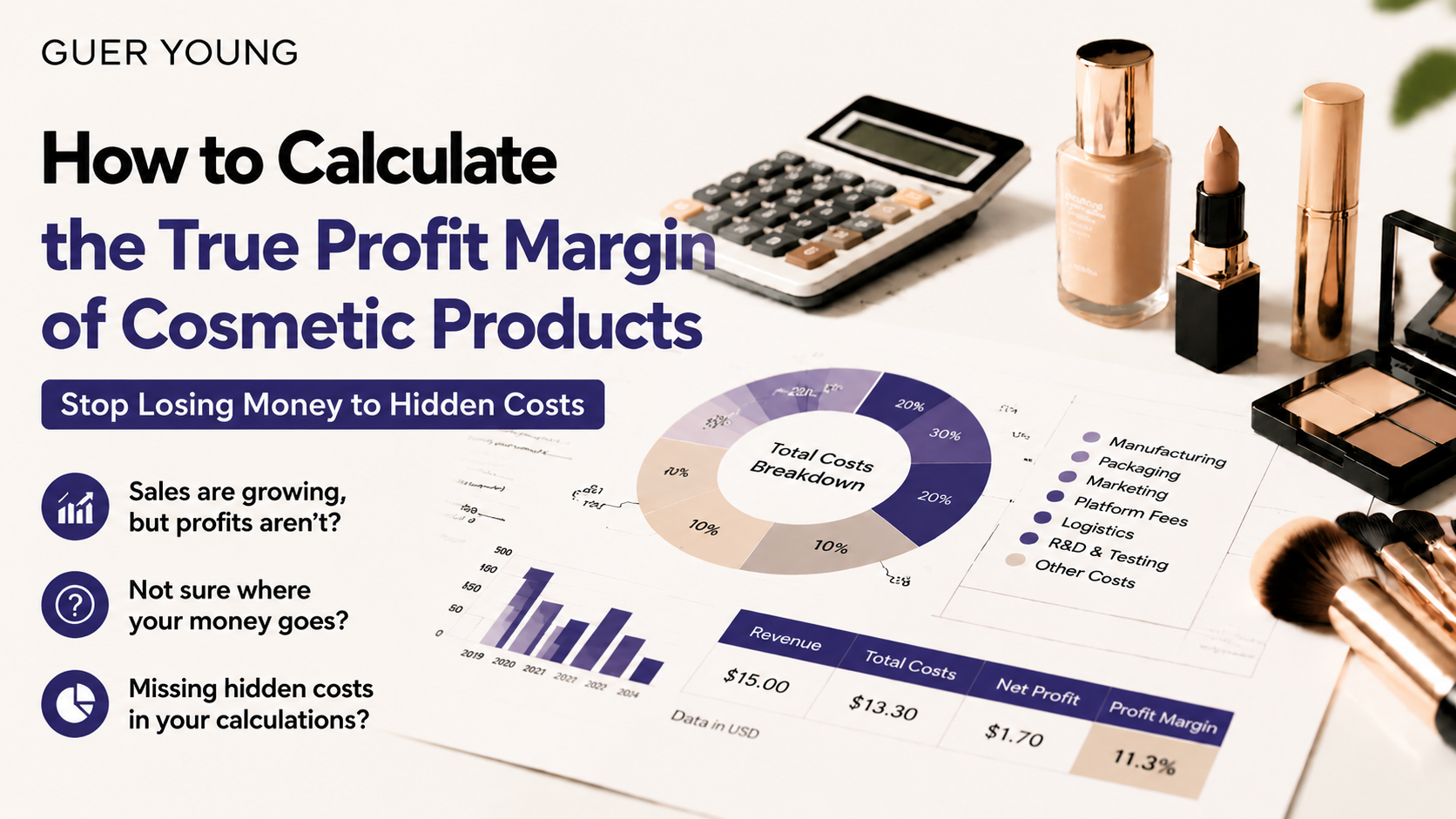
Consider the following example for an eyeliner product sold at $15.00:
| Cost Item | Cost |
|---|---|
| Manufacturing | $4.20 |
| Packaging | $1.10 |
| Regulatory Testing | $0.40 |
| Shipping & Warehousing | $0.90 |
| Platform Fees | $1.50 |
| Advertising | $3.40 |
| Returns & Customer Support | $0.60 |
| Operational Costs | $1.20 |
Total Cost: $13.30
Net Profit: $1.70
True Profit Margin: 11.3%
Although the product initially appeared highly profitable, the actual margin is significantly lower after considering all associated costs.
This explains why many cosmetic brands experience strong sales growth without seeing meaningful increases in profit.
Why Hidden Costs Matter More Than Manufacturing Costs
When profit margins begin to shrink, many brands immediately look for lower-cost manufacturers.
While reducing production costs can certainly help, manufacturing is only one part of the total cost structure. Hidden costs—including product development, logistics, marketing, inventory management, and customer service—often have a much greater impact on profitability than businesses initially expect.
Choosing the lowest manufacturing price may actually increase overall costs if it results in:
Higher defect rates
Longer production lead times
Multiple packaging revisions
Customer complaints
Inventory delays
Missed product launch opportunities
Instead of focusing solely on unit price, successful beauty brands evaluate the total lifecycle cost of every product.
Profitability Starts Long Before Production
Many profitability challenges are created long before a product enters the market.
For example:
Multiple formula revisions increase R&D expenses.
Premium packaging choices significantly raise production costs.
Delayed regulatory approvals postpone product launches.
Poor project planning results in missed seasonal sales opportunities.
This is why experienced beauty brands consider profitability during product development—not after the product has already launched.
Companies such as GUER YOUNG follow this mindset by evaluating formulation, packaging, manufacturing processes, and supply chain efficiency throughout the development process. Rather than focusing solely on factory pricing, this approach helps brands identify cost-saving opportunities before production begins and reduces unexpected expenses later in the project.
A Practical Cost Breakdown for Product Managers
To better understand product profitability, product managers should divide costs into five major categories.
1. Research and Development Costs
These include:
Formula development
Prototype samples
Stability testing
Regulatory documentation
Although these are upfront investments, they should be allocated across projected sales volume.
2. Manufacturing Costs
This category includes:
Raw materials
Packaging components
Filling and assembly
Quality control
Production labor
These are usually the easiest costs to measure, but they rarely represent the complete financial picture.
3. Marketing Costs
Marketing expenses may include:
Digital advertising
Influencer partnerships
Social media campaigns
Retail promotions
Marketplace advertising
For many emerging beauty brands, customer acquisition costs can become one of the largest expenses associated with each product.
4. Operational Costs
Ongoing operational expenses include:
Warehousing
Shipping and fulfillment
Customer support
Product returns
Marketplace commissions
Although each expense may appear relatively small, together they can significantly reduce net profit margins.
5. Risk Costs
Brands should also prepare for unexpected business expenses such as:
Raw material price increases
Currency exchange fluctuations
Product returns
Slow-moving inventory
Packaging supply shortages
Including these risks in financial planning leads to more accurate pricing decisions and healthier long-term profitability.
Improving Profit Margins Isn't Just About Raising Prices
When margins decline, increasing retail prices may seem like the simplest solution.
However, in today's highly competitive beauty market, higher prices can reduce customer demand and weaken market competitiveness.
Instead, many successful brands focus on improving efficiency by:
Optimizing formulations without compromising quality
Reducing unnecessary SKUs
Shortening product development timelines
Strengthening supply chain collaboration
Increasing customer retention to lower acquisition costs
Many OEM and ODM manufacturers are adopting similar strategies. For example, GUER YOUNG emphasizes close collaboration between R&D, manufacturing, and supply chain management across products such as eyelash growth serums, mascaras, eyeliners, and brow gels. This integrated development model can help brands improve project efficiency while maintaining greater flexibility throughout the product lifecycle.
Build a Cost Structure Before You Scale Your Business
For beauty brand founders, profit margin is more than a financial metric—it reflects the overall health and sustainability of the business.
Growing sales without understanding your complete cost structure can quickly lead to shrinking margins and unnecessary financial pressure. By identifying every cost involved—from research and development to manufacturing, logistics, marketing, operations, and after-sales support—you gain a much clearer picture of where profits are earned and where they are lost.
As competition in the cosmetics industry continues to increase, more brands are prioritizing efficient product development, flexible manufacturing, and stronger supply chain collaboration. Companies like GUER YOUNG, which specialize in beauty and color cosmetics development and manufacturing, reflect this broader industry trend by helping brands streamline product development and better manage overall project costs through integrated OEM/ODM capabilities.
Ultimately, understanding the hidden costs behind every cosmetic product allows founders and product managers to make smarter pricing decisions, improve profit margins, and build a more resilient beauty brand for long-term growth.


andy.li@gueryoung.com

We have 10 years of experience, focusing on the development and sales of high quality eyelash growth serum, mascara, eyebrow gel, eyebrow color and other products. We also offer custom services, from tube
design to cosmetic fillings and packaging


Room 1, C3 Factory Building, No.8803 Zhuhai Avenue, Lianwan Industrial Zone, Pingsha Town, Gaolan Port Economic Zone, Zhuhai, Guangdong,China
QUICK LINKS
D Zone,5/F, NO.8 CuiZhu 5th Street,
Qianshan Xiangzhou District,Zhuhai,
Guangdong,China,519070

lynn.zhou@gueryoung.com
winnie.zhong@gueryoung.com
niki.xu@gueryoung.com